Showing posts with label lighting. Show all posts
Showing posts with label lighting. Show all posts
Friday, November 25, 2011


Tuesday, November 22, 2011
Main light? A mirror!
 That's right, the main light I have used for this shot is a circular mirror where I bounced the light of an SB800. The reason for this is because the snoot that I have doesn't give me a perfect circular rim of light and most of all because not long ago I watched an interesting video about lighting a product with mirrors and it looked pretty interesting to me. Interesting and challenging I add, in fact it is all about studying the angle of the light, a study that I believe most studio photographers had to go through at one point in their career. Since I don't use continuous lights, I had some trouble in finding the right angle to achieve the shot I wanted, it costed me a bit of batteries life through a bunch of test bursts until I figured out where the circle was going to sit for my shot. Hence, contrary to the appearences the speedlight is on camera right gridded it with a Honlphoto grid to control the light spill as much as possible, and it bounces the shaft against a circular mirror that becomes the main light and lit the three lures. Everything has been controlled with the Nikon CLS system. Camera Nikon D7000 with Nikkor 60mm f2.8 micro lens.
Tuesday, October 4, 2011
Orbis Ring Flash for macro shots
The guys at Orbis Ring Flash have been so kind to post an article about my product photos using the Orbis Ring Flash, you can find it by clicking here
Thanks!
Thanks!
Sunday, January 2, 2011
Lights and metal
The general opinion is that is very difficult to light metal properly. The light bounces all over the place and highlights can become a nightmare. Anyway, here's the result of my latest studio work with the new Accurate reels that i just received. Many shots of details and some full reel body.
This is the technical list
2 X SB800 speedlights triggered with CLS
One speedlight through Lastolite EzyBox
One Speedlight through Orbis Ring Flash
One white reflector
Nikon D90 with Tokina 100mm f2.8 Macro
Black Vinyl background
Water spray
This is the technical list
2 X SB800 speedlights triggered with CLS
One speedlight through Lastolite EzyBox
One Speedlight through Orbis Ring Flash
One white reflector
Nikon D90 with Tokina 100mm f2.8 Macro
Black Vinyl background
Water spray
 | ||
| Detail of the spool and the body of the reel |
 | ||
| Detail of the drag lever and drag preset |
 |
| Side plate with accucast knob |
 |
| Side plate with strike limit |
 |
| Side plate with "lefty" sing for reels with left handle |
 |
| Knob handle |
 | |
| The whole reel |
 |
| Whole reel sprayed with water and with a Theos jig on one side |
Tuesday, October 26, 2010
Using 2 Lastolite Ezybox Hotshoe's and a TriFlector
There are videos around who are good enough to explain how to work with certain tools, and show how effective they are. For the little strobes lovers the Lastolite EzyBox is a great light diffuser, that should be in our bag all the time. I use it a lot for my products stuff because is easy to set up, fast to use and delivers a great light. Here's Mark Cleghorn at work showing how to properly use it fo a double portrait session.
Thursday, September 23, 2010
Gregory Heisler whiteboards his Rudy Giuliani Time Magazine cover
Now, if you think that shooting Bruce Sprinsteen sitting on a stool was an easy task, check this one. Rudolph Giuliani 65 stories up, with Heisner making it look as if he is lit by the New York lights instead of a complicated Prophoto set of artificial lights.
I'm amazed looking at the image and thinking of what has been put in the making of it. Incredibly smart and somehow logical. These videos are of much help for someone who is trying to learn how to deal with lights, thus the creativity must be there, for any different situation that might arise. That one, either you have it or not.
I'm amazed looking at the image and thinking of what has been put in the making of it. Incredibly smart and somehow logical. These videos are of much help for someone who is trying to learn how to deal with lights, thus the creativity must be there, for any different situation that might arise. That one, either you have it or not.
Monday, September 20, 2010
Gregory Heisler whiteboards his Bruce Springsteen Time Magazine cover
Gregory Heisler is one of those photographers that can make look simple the most difficult shootings. He's a regular on the Time Magazine cover, and in this short video he explains his set up for the session with Bruce Springsteen. You listen, you follow his sketch and you think is easy, then you try do do the same and it sucks...
Have a look at the video and take notes :-)
Have a look at the video and take notes :-)
Tuesday, July 27, 2010
Lastolite EzyBox

Thursday, July 22, 2010
Orbisflash for still life
For this test we found quite an unusual subject for the Orbisflash, a still life. I’m pretty sure that this ring flash was not designed for anything like that, but we had fun for half an hour trying different angles, and finally comparing it with a Lumiquest Softbox III, a Lumiquest Snoot and finally a bare SB800.
 In this first image we have the Orbisflash on axis with the lens. That is, the lens goes through the hole :-) . The light gently wraps the whole subject
 Now we moved the Orbisflash from the lens to camera left. The light is still nice and wrapping, we have more shadows and probably a more interesting picture
 The Orbisflash is on top of the subject. This is the option I like the least, the light is a bit dull and there’s quite a loss of contrast and details.
 Here we have the Lumiquest Softbox III right on top of the lens, trying to mimic the direction of light of the Orbisflash. The result is quite similar to that of image one, thus the light is not as wrapping and creates more edges
 Lumiquest Softbox III on camera left. Compared to the second image we have more contrast here, darker shadows and stronger highlights. Is more contrasty
 Softbox III on top of our garlic. The result is not too different from the one we made with the Orbisflash with the same settings.
 Here we go for a very hard and narrow beam of light. The Lumiquest Snoot creates some kind of bad chiaroscuro, with very harsh and unflattering shadows.
 Another hard light configuration. The SB800 is now bare, and the light again very unflattering. Lots of unpleasant contrast, same as in the previous example, yet we have a wider beam of light and it spreads more around the subject.


Thursday, May 13, 2010
Three Books for the Lighting enthusiasts
If you're a lighting fanatic I got three books to suggest you. I red them all, they are quite easy to understand, bring a lot of solutions, ideas and practical tips, and sure teach you one thing or two about lights. Any kind of light. The author is Kirk Tuck, a photographer based in Austin, Texas, who has a great degrees of knowledge about what he does: working with lights.
Have a good reading!
Have a good reading!
Friday, April 16, 2010
Ringflash Vs Rayflash
This toy makes me look at my Visa with evil eyes. I've been about to buy one already three times, and I don't know for how long I will be able to resist. I don't know how it would work for my fishing photos, but is sure interesting for general portraits
Have a look at this video, is quite interesting
Have a look at this video, is quite interesting
Thursday, April 15, 2010
And the winner is....
Just got the news that one of my images has won the march contest of the Lumiquest group in Flickr. Thanks a lot guys, I very much apreciate
Lumiquest web page
Lumiquest web page
Monday, April 12, 2010
Video information about Nikon CLS
Since it took me a bit to understand how the Nikon CLS system worked, I think it could be of some use for those willing to master this powerful tool to watch these videos
The "Commander" use is for me the #1 choice both when I'm indoor and outdoor, especially when using the SB600 or the SB800, very reliable and powerful units. You can trigger your flashes either with the pop up flash of your Nikon or using the SU800 commander. The important thing is that the receiver, which normally is on the lower right end of your flash, can actually see the light from the pop up or receive the infrared signal from the SU800.
These videos are not new, they've been out for a while, as well as the CLS, but they are still of much use.
The "Commander" use is for me the #1 choice both when I'm indoor and outdoor, especially when using the SB600 or the SB800, very reliable and powerful units. You can trigger your flashes either with the pop up flash of your Nikon or using the SU800 commander. The important thing is that the receiver, which normally is on the lower right end of your flash, can actually see the light from the pop up or receive the infrared signal from the SU800.
These videos are not new, they've been out for a while, as well as the CLS, but they are still of much use.
Tuesday, December 22, 2009
Drew Gardner - An "Epic" photographer
I admire photographers who are good with lights. I also admire photographers who are creative. Hence, I guess, I have at least a couple of very good reasons to admire this guy, who not only knows how to light a scene, but is also able to create such an amazing image with this incredible atmosphere. His name is Drew Gardner. He's got a DVD available, check is web site www.thedarkart.com to find where is available. This video is a trailer of the above mentioned DVD, Epic Location Photography
Saturday, December 19, 2009
The Dark Session
The use of artificial light is, as the followers of this blog know, very high on my list. I got absolutely hooked by the use of strobes, speed lights and studio light, especially after becoming a follower of the Strobist community myself.
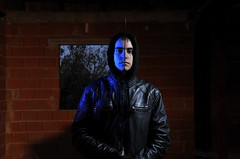
We did the session inside a house in construction. 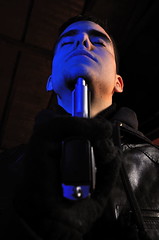
We worked around different kind of situations, mostly based around the idea of the dark warrior or something alike. 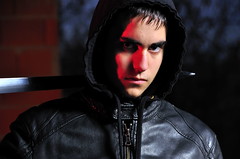
The result is mixed. There’s so much to learn about lights and their fine tuning that I can’t expect major improvement overnight, yet a couple of these images make me happy and proud. The most disappointing is probably the third one, where the light coming from the umbrella is too strong and kills a bit of the atmosphere.
If you need any info about the setup don’t hesitate to contact me.
Tuesday, September 15, 2009
A good man in an evil world
Life is strange, and this is one of the main reason why is worth living it as deep as you can. One day you’re trashed, work sucks, had an argue with your wife, and the following day somebody rings at your door and a big box is handed to you.
You know who’ve sent you the box, is a friend down in Andalusia, he called you the day before to let you know that something would come, but you don’t have a clue of what is inside the box. The BIG box, I should say, and is heavy.
The phone rings, you leave the package in the hall and answer. Blah, blah, blah, hang up. Damn! Lots of e-mails coming, you start opening them and replying. The box sits there waiting for you. Finally things get back to normal and you can resume your unpacking.
What the hell is this? A big bag shows inside the box and is quite heavy. You start pulling it from the cardboard parcel and you can read on one side “Starblitz”. A bell rings. Your dormant brain cannot realize straight away but you have a hint. Then...is light! Beat me; Starblitz is a lighting equipment maker so this must be a studio lighting kit or something like this.
 The bag’s zip slides too slow compared to my heartbeat, but when I finally manage to open it every doubt disappear. It truly is a Studio Lighting Kit (Starblitz DI 160) with 3 lights, 2 soft boxes, one translucent umbrella, 3 stands, 1 radio trigger/receiver and the comfortable and handy bag.
Cannot believe it. During the last few weeks I have been browsing the various options to put together a studio light set and all of a sudden, without knowing my thoughts somebody has the idea to buy it for me.
Paquito, thank you very much, this is THE GIFT, one of the few things that in this very moment I could have asked for and really wanted to have.
If you’re a good human being, and I think I belong to this league, those you pick as your friends are good too and things like this can happen. Yes, I’m a lucky bastard!
I’ll be posting some pictures shot with the kit soon.
You know who’ve sent you the box, is a friend down in Andalusia, he called you the day before to let you know that something would come, but you don’t have a clue of what is inside the box. The BIG box, I should say, and is heavy.
The phone rings, you leave the package in the hall and answer. Blah, blah, blah, hang up. Damn! Lots of e-mails coming, you start opening them and replying. The box sits there waiting for you. Finally things get back to normal and you can resume your unpacking.
What the hell is this? A big bag shows inside the box and is quite heavy. You start pulling it from the cardboard parcel and you can read on one side “Starblitz”. A bell rings. Your dormant brain cannot realize straight away but you have a hint. Then...is light! Beat me; Starblitz is a lighting equipment maker so this must be a studio lighting kit or something like this.
 The bag’s zip slides too slow compared to my heartbeat, but when I finally manage to open it every doubt disappear. It truly is a Studio Lighting Kit (Starblitz DI 160) with 3 lights, 2 soft boxes, one translucent umbrella, 3 stands, 1 radio trigger/receiver and the comfortable and handy bag.
Cannot believe it. During the last few weeks I have been browsing the various options to put together a studio light set and all of a sudden, without knowing my thoughts somebody has the idea to buy it for me.
Paquito, thank you very much, this is THE GIFT, one of the few things that in this very moment I could have asked for and really wanted to have.
If you’re a good human being, and I think I belong to this league, those you pick as your friends are good too and things like this can happen. Yes, I’m a lucky bastard!
I’ll be posting some pictures shot with the kit soon.
Friday, April 10, 2009
Flash among the ruins
Last week I was in Rome with the family and decided to go with the wife to Villa Adriana, a magnificent ruin near Tivoli, not far from the capital. The Villa was built as retirement place for the emperor Adriano, around II ac on an area of 300 hectares.
This is a magnificent place. Simply amazing, I'd say. I highly recommend anybody visiting Rome or Italy for that matter to spend an afternoon there.
Of course there's a lot of monuments, ruins, lakes, pools, gardens to see and photograph and during one of the least inspired days of my life I came up with some experimental shots. At least experimental for me. First I decided to use the flash as much as I could in order to handle a bit the major exposure difference I was finding from a spot to another. Then, for the same reason I placed a Graduated filter in front of the lens. Even though sometimes in a different manner. Tripod was left at home.
 This first shot is an arch opening to a beautiful pool surrounded by columns. This is called the Teatro Marítimo, one of the most outstanding areas of the Villa.
As you can see from the first image I exposed for the sky with the result that the arch is dark and underexposed. Image straight from camera RAW
 In this second image I took the SB600, put it off camera and fired it through the CLS. The arch is now properly exposed and the sky as well. There was people looking at me when I was taking these photos and they were pretty puzzled by the fact that I was lighting a piece of history with a small flashgun. To be honest with you I felt weird too, but driven by my experimental mood, I proceeded. The flash was handheld camera left and pointed upward with a slight angle, the maximum allowed by my arm's lenght. Image straight from camera RAW
 As far as the Grad filters is concerned I used it in this other situation where the pavement was well lit and the roof too dark. In this image you can see the straight result, with no filter. Image straight from camera RAW
 Then I placed the filter upside down, darkening the floor and correcting the exposure difference. Nothing to rave about, I think many photographers have been using this for ages but it was fun for me to try it and the results quite pleased me . Image straight from camera RAW.
Maybe I repeat myself but this is not the blog of a professional photographer. I know about shooting a guy with a fish but everything else is a learning curve for me and what I share with those who wants to read me, is simple day by day field work. I'm glad if I can help but is sure not my intention to "teach" anybody, in a straight manner.
This is a magnificent place. Simply amazing, I'd say. I highly recommend anybody visiting Rome or Italy for that matter to spend an afternoon there.
Of course there's a lot of monuments, ruins, lakes, pools, gardens to see and photograph and during one of the least inspired days of my life I came up with some experimental shots. At least experimental for me. First I decided to use the flash as much as I could in order to handle a bit the major exposure difference I was finding from a spot to another. Then, for the same reason I placed a Graduated filter in front of the lens. Even though sometimes in a different manner. Tripod was left at home.
 This first shot is an arch opening to a beautiful pool surrounded by columns. This is called the Teatro Marítimo, one of the most outstanding areas of the Villa.
 As you can see from the first image I exposed for the sky with the result that the arch is dark and underexposed. Image straight from camera RAW
 In this second image I took the SB600, put it off camera and fired it through the CLS. The arch is now properly exposed and the sky as well. There was people looking at me when I was taking these photos and they were pretty puzzled by the fact that I was lighting a piece of history with a small flashgun. To be honest with you I felt weird too, but driven by my experimental mood, I proceeded. The flash was handheld camera left and pointed upward with a slight angle, the maximum allowed by my arm's lenght. Image straight from camera RAW
  As far as the Grad filters is concerned I used it in this other situation where the pavement was well lit and the roof too dark. In this image you can see the straight result, with no filter. Image straight from camera RAW
 Then I placed the filter upside down, darkening the floor and correcting the exposure difference. Nothing to rave about, I think many photographers have been using this for ages but it was fun for me to try it and the results quite pleased me . Image straight from camera RAW.
Maybe I repeat myself but this is not the blog of a professional photographer. I know about shooting a guy with a fish but everything else is a learning curve for me and what I share with those who wants to read me, is simple day by day field work. I'm glad if I can help but is sure not my intention to "teach" anybody, in a straight manner.
Thursday, March 12, 2009
Flowers anyone?
 A while ago I set up my mini portable studio to do a bit of work on some nice flowers I had bought to my wife. It took me a good deal of the afternoon to find the light I liked the most, and even now I'm not 100% sure that this is THE best light. Thus, maybe there's no BEST light. what could be good for me might not be good for you, and viceversa. Same thing happens with colors and here you have a clear example.
 In both images I had one SB600 through translucent umbrella on camera right, an old and uncontrollable Metz to light the background triggered with a slave and a reflector on camera left. It was before my 4 flashes set, and the old Metz spilled a bit too much of light here and there, yet these images are important to me, it was my first experiment with flowers. By the way, I like the blue one better....
Tuesday, March 3, 2009
How to complicate your life...
I do funny things. Not happy of taking the normal fishing pictures you can get using available daylight or with the help of a small flashgun, I decided to do it the my way, complicated. That is. During my last trip I brought with me 4 flashes. To be exact, 3 x SB600 and one Metz 54 recently bought as a bargain. To fire these lights I had with me 3 Skyport receivers and eventually one slave, that due to the strong light wouldn't work, or better say, would work whenever it wanted.
Now, to put together all these lights and make them work the way I wanted, I had to carry also my Manfrotto 001B light stands. The Manfrotto Justin Clamp. Another smaller clamp. Two small translucent umbrellas. Gaffer tape. You name it... All this stuff found place in my suitcase leaving home many lures I could have used for fishing, but this is what I choose, so much for the lures frenzy.

The idea was to put together two strobes on tne 001B stand, and one on the Justin Clamp as a backlit unit. The latter would not work properly because people holding a fish cannot be also asked to stand still in one very place and anyway, the distance between the rail where I would clamp the flash and the fisherman was always very short so the use of such light was pointless. I ended up lighting the subject from one side, and naturally backlit by the sun itself, using two flashes on the light stand but, at one point, in my mighty effort to overpower the sun I added a third flashgun to the stand ad went for the real thing.
Imagine what kind of chaos I have generated on board. Every time somebody had a decent fish I was removing the stand from the "safe" place, unfolding the plastic bag covering the flashes, turning all the darn receives and the flashes on, positioning the stand and the lights in order to have one pointing at the fisherman and the other at the fish, and start shooting. The light for the fisherman was usually half the power of those used to lit the fish, wouldn't always work flawless but it was pretty much under control. Anyway, big work. Tough, and easy to make mistakes, and mistakes I made, quite few many. Thus, the results in some of the photos were extremely rewarding and unique, hence, for as weird as it seem I will keep using my life-complication-combo trying to figure out how to make things roll easier.
 Eventually, Lastolite seem to have heard my screams from the Maldives and put together a great gear : The Triflash. Strobist brought the news last week or so and I figured out is what I really need to buy in the nearest future (read, as soon as it is available). Is a triple flash bracket you can stick into your light stand and use with one, two or three flashes, as you like. As simple as that, great ideas don't need to be complicated anyway. Some more detailed info are available here http://www.lastolite.com/triflash.php
Now, to put together all these lights and make them work the way I wanted, I had to carry also my Manfrotto 001B light stands. The Manfrotto Justin Clamp. Another smaller clamp. Two small translucent umbrellas. Gaffer tape. You name it... All this stuff found place in my suitcase leaving home many lures I could have used for fishing, but this is what I choose, so much for the lures frenzy.
The idea was to put together two strobes on tne 001B stand, and one on the Justin Clamp as a backlit unit. The latter would not work properly because people holding a fish cannot be also asked to stand still in one very place and anyway, the distance between the rail where I would clamp the flash and the fisherman was always very short so the use of such light was pointless. I ended up lighting the subject from one side, and naturally backlit by the sun itself, using two flashes on the light stand but, at one point, in my mighty effort to overpower the sun I added a third flashgun to the stand ad went for the real thing.
Imagine what kind of chaos I have generated on board. Every time somebody had a decent fish I was removing the stand from the "safe" place, unfolding the plastic bag covering the flashes, turning all the darn receives and the flashes on, positioning the stand and the lights in order to have one pointing at the fisherman and the other at the fish, and start shooting. The light for the fisherman was usually half the power of those used to lit the fish, wouldn't always work flawless but it was pretty much under control. Anyway, big work. Tough, and easy to make mistakes, and mistakes I made, quite few many. Thus, the results in some of the photos were extremely rewarding and unique, hence, for as weird as it seem I will keep using my life-complication-combo trying to figure out how to make things roll easier.
 Eventually, Lastolite seem to have heard my screams from the Maldives and put together a great gear : The Triflash. Strobist brought the news last week or so and I figured out is what I really need to buy in the nearest future (read, as soon as it is available). Is a triple flash bracket you can stick into your light stand and use with one, two or three flashes, as you like. As simple as that, great ideas don't need to be complicated anyway. Some more detailed info are available here http://www.lastolite.com/triflash.php
This is how my next boat lighting set up will look like, maybe if is very windy I will skip the umbrella but I'm sure this will make my life easier. Can't wait to try that.....
Wednesday, February 4, 2009
Minimalist Lighting: Professional Techniques for Location Photography
 My 2 humble cents. Check out this book by Kirk Tuck. Is an understandable, useful, simple and yet terrific book about the use of small location lights. He not only explains all the technical requirements, tricks and useful tips to get the best out from even the cheapest goods, but he also gives practical examples with images and drawings that explain how to practically build a successful lighting set up for many different situation
I think this is the right book for those who, like myself, love to use the small portable flash and want to get the best out of its potential
This is Tuck's website if you care to read more about him and his work http://www.kirktuck.com/Blog/Blog.html
There's also a #2 coming dedicated to studio lighting techinque, will be out in April, check this http://www.kirktuck.com/Book_2.html
Subscribe to:
Posts (Atom)


