Stock Photo Gallery

Showing posts with label sb800. Show all posts

Wednesday, July 18, 2012

When natural light and a reflector can help creating a studio shot


When playing with lights sometimes you never know how many you might need and if you don't have enough, well you still have the sun to help you. For these photos I had two SB800 but, to achieve the desired effect I needed an extra help.

No "moving" reflector has been used for
this shot
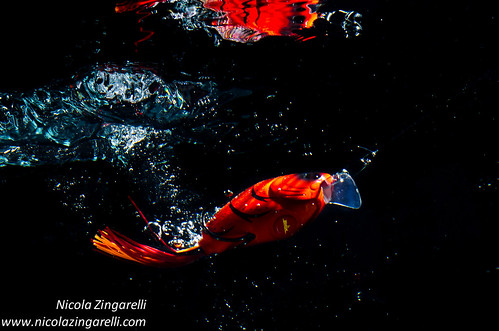
First of all let’s see how I organized the table. I have a squared piece of glass sitting on top of four plastic cups to separate it from the base. Under the glass there is one SB800 with a red gel, above the glass we have the Molix' Finder 110 sprayed with water. Off camera right slightly above the subject is the other SB800 through a translucent umbrella, while the window of the room is opened and its position is again on camera right.


Here we are using the "moving" reflector
but the SB800 with the red gel has been turned off
On camera left a friend is holding a silver reflector with a bit of a hammered surface; is not flat and smooth and it works better for what I want to achieve. The exposure time is 2 seconds, enough to be able to play with the light coming from the window and mix it with the speedlights.


Shot taken with the setting described in
the post
When I take the shot my friend is moving the reflector for the 2 seconds of the exposure and the light coming from the uneven silver surface paints some sort of “blurred” background with liquid lights and shadows while the product has been perfectly lit by the SB800. The water sitting on the glass surface also helps achieving this result but as you can see in the three shots, the difference really pops out.


It is very exciting for me to always explore new ways of lighting a product, the studio gives you so many different opportunities and the subjects never complain J I hope this give you some ideas for your studio work and if you think of a way to improve it your comments are always welcome.

Tuesday, April 3, 2012

Making of...

How do you think I made this photo? Few hints: There's one main light and a fill light and in the background there's a .... The exposure is 4 seconds, does it ring a bell? New high tech stuff can make miracles for your studio shots

Monday, December 12, 2011

Putting the lights within the frame. Sculpo crankbait by Molix, studio shot

Molix Sculpo lure. Studio shot with three lights by Nicola Zingarelli

One of the simple rules I have understood in this photography business is that eventually there are NO RULES!

I have seen some cool images of guys putting their lights within the frame and for this reason I decided to try the same in one of my studio shots. What I wanted to reply, in a way more reduced scale, were the stadium or stage lights, all pointed to the subject that is the center of attention.

To achieve that I had to work on a table longer than usual and using a wider lens, otherwise I would have either missed the two SB800 that you can see in the frame, or too close to the subject with serious problems, at least for me, to control the light. In my first attempts I only used the two visible light, but even though the lure is translucent I was missing a good deal of light on it. After several try with reflectors I had to pick up a third light, Metz 58, and use it at its lowest power with a tight zoom and a grid to make the Sculpo pop up.

The result is in front of your eyes, I love the lights in the background even though I would have love them showing a "star" instead of the rectangular shape of the SB800, and I would have loved the product to be a bit bigger but I think I can work that out a bit.

If anybody has an idea of how to improve this kind of images please feel free to drop a comment either in the blog or in Flickr, I'd highly apreciate.

Tuesday, November 22, 2011

Main light? A mirror!

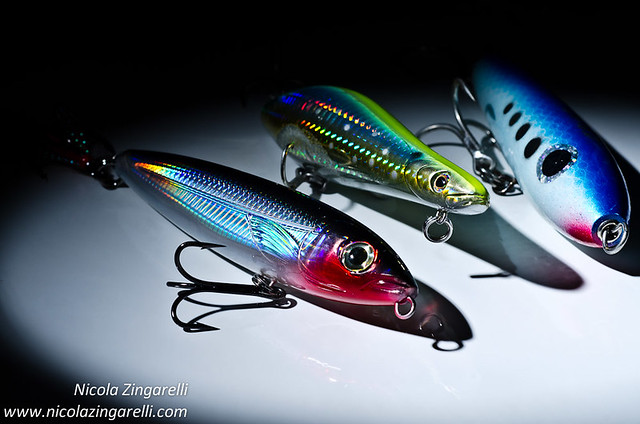
Studio shot for a magazine, three walking the dog lures lit with one light reflected against a circular mirrorThat's right, the main light I have used for this shot is a circular mirror where I bounced the light of an SB800. The reason for this is because the snoot that I have doesn't give me a perfect circular rim of light and most of all because not long ago I watched an interesting video about lighting a product with mirrors and it looked pretty interesting to me. Interesting and challenging I add, in fact it is all about studying the angle of the light, a study that I believe most studio photographers had to go through at one point in their career. Since I don't use continuous lights, I had some trouble in finding the right angle to achieve the shot I wanted, it costed me a bit of batteries life through a bunch of test bursts until I figured out where the circle was going to sit for my shot. Hence, contrary to the appearences the speedlight is on camera right gridded it with a Honlphoto grid to control the light spill as much as possible, and it bounces the shaft against a circular mirror that becomes the main light and lit the three lures. Everything has been controlled with the Nikon CLS system. Camera Nikon D7000 with Nikkor 60mm f2.8 micro lens.

Saturday, October 22, 2011


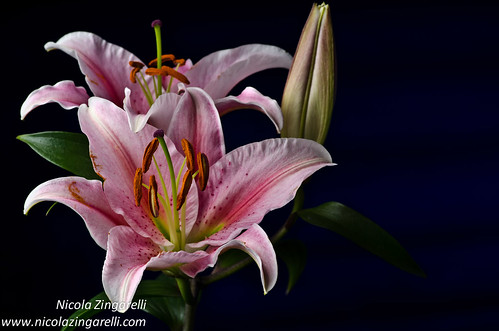
Studio shot of white and pink flowers with a two light set by Nicola Zingarelli
Flowers make for beautiful and very patient subject for your studio photo sessions. They don't move and have that inner (and outer) beauty that just need a bit of sensibility to come out and fill the frame. Thing is that I’m not a flower photographer, at least not one of those that ravenously search fields and botanical gardens, I’m rather one of those that when there’s a flower at home grabs it and put it in front of the camera. I’m also the one who usually brings the floral gifts so at least I can pick those I think can make a nice subject too. 
Photographing flowers for me means soft light, soft images, and mostly a low key shot, well at least now, maybe tomorrow I’ll go hard and high key, truly don’t know… My set for this session was based in two lights, one for the flower and the other for the background. I didn’t use any reflector pursuing my quest of a light gradually fading and leaving an area into a certain degree of darkness. The light for the background carried a blue gel, in order to create a color contrast with the subject and also because I love blue background, they’re way classy!

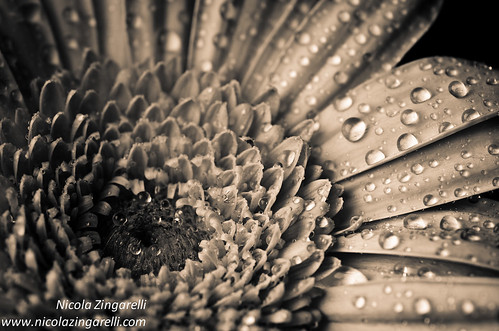
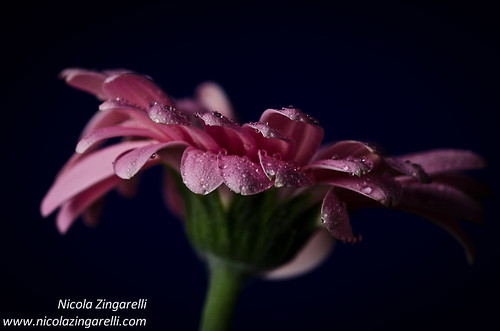
The main light for all shots was one of my SB800 through a Lastolite EzyBox on camera left, while the other SB800 was gridded with a Honlphoto grid pointing at the black background. For each one of these three shots I was looking for something different and I hope it shows. Details, lighting, point of view and depth of field and of course, there has been a bit of work in Lightroom to come up with the final image. Water spray was used to enhance reflections and textures in a couple of flowers, and I think it is a good plus. Hope you like them, if you need any further information please drop a comment

Saturday, October 15, 2011

Lures diving in the water, studio shot with two lights on a blackbackground


Lure diving in the water, studio shot with two lights on a black background by Nicola Zingarelli
Yesterday a friend showed me an image of a lure swimming in the water on a black background. This was some sort of relief because when I did my first test, I had to quit the idea of using a black background because reflections flare and light spills were everywhere. So yesterday, with renewed energies I set up my studio and the first thing I did, in addiction of putting my black vinyl background, was to cover 2 sides of the tank with black cardboard.
I also got rid of the large lights, any umbrella or softbox would send too much light out of control so I decided to go hard and small. One SB800 was set with its dome and the other with a Honlphoto Grid one of each of the narrow side of the tank, power settings changed a lot during the session so is hard to tell which has been the most commonly used. I also switched the main light from one speedlight to the other, again hard to tell some sort of rules.
Once everything was set the first test shots were suggesting a decently dark background that could be easily manipulated in Lightroom, giving me the proper black I needed. Now I needed to find a way to focus on the lures, so I put one in the middle of the tank, same distance from the two longest walls, and hoped for the best. I obviously took the focus with the lure under the water, I have read somewhere that the liquid element not only increase the magnification of the objects but also swift the focus point.
Since I was on my own I needed something that could help me moving the lures, for this reason I tied them to a thin fishing line of the length of the longest side, with a weight on the other end. I could pull the lure to one end of the tank, the weight would lift up to the opposite edge and once I released the lure the weight would pull it to the other side … gravity!
I shot with the camera parallel to the wall of the tank, with a bit of angle from above, a pretty high angle, and a very low one and achieved different results. Parallel or with a small angle worked fine, the images are sharp when the focus is on the money, but from a very high or very low angle, like in this image, sharpness and focus became an issue and I believe that is because of the thickness of the glass, that would create refraction and a bit of distortion. I’m not an expert on this matter but I believe I’m not far from the scientific explanation.
I made so many shots that my D7000 was smoking, well at least it was very hot and sometimes needed a break to process the files. The SB800 showed how good they are for the hard work, not a single complain, never stopped, always recycling fast and with just one set of batteries. Some intensive processing in Lightroom followed, I needed the blacks to be black, and the lures to be sharp and well exposed. It has sure been a challenging experience, I have made an unlimited number of mistakes and probably none of the images is really good, but it has been my first step, hopefully I’ll do it better next time.

Friday, September 2, 2011

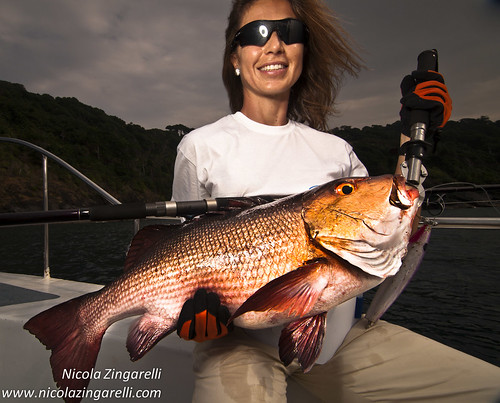
Andaman Islands, India. Red Snapper (Lutjanus bohar) caught with a stickbait. SB800 through Orbis Ring Flash

The Orbis Ring Flash sure is a great light modifier for my fishing portraits, is just a tad bulky to carry on a suitcase full of lures, reels and all kind of tackle. Fort this reason I not always bring it with me, but when I do I never regret. She is pretty, has a gorgeous smile and can perfectly hold a fish, a great plus for a fishing photo. I love the specular ring on her sunglasses, is a kind of brand signature of the Orbis.

SB800 through Orbis Ring Flash triggered with Nikon CLS

Monday, December 20, 2010

Macro shots of products with a Fisheye lens

I’ve been thinking for a while about doing some macro stuff with the fisheye, and today I finally gave it a try. I have a Nikkor 10.fmm f2.8 fisheye lens that I really love. I don’t use it as much as I would because it the pictures tend to get tiring, but every once in a while it comes handy when doing some fishing portraits or landscapes.

This is quite an interesting result.
Not many people know that this lens can focus at a distance of…. I don’t know exactly but basically, you can rub the lens against the subject, as I proved once again today. You can then imagine how special of a macro lens can be. Everything is dramatically distorted; distance between foreground and background absolutely exaggerated, and quite some problems not get in between the light and what you are shooting

Still something that at least will make you smile
Well, if I can be let's say at 2cm from the subject, and have a softbox on top of me or slightly facing towards me, I will have to do some magic trick not to have the shadow of the camera, or my head, covering half of my product. Another issue is how to trigger the flash with the CLS. If I’m under the softbox, it is quite difficult that the sparkle of the pop up on my Nikon can be seen by the SB800 remote unit that is covered by the softbox itself. I leant it today the hard way.

Here we are getting worst, nothing really interesting about it
To find a solution I had to pull the good old’ remote cable and trigger the flash with that one, while putting the other flash in slave. Too bad my chord is so short that the softbox, most of the times, was falling on top of myself and the product. 
Anyway, when I started shooting the lure I had the confirmation that another of my fear was being confirmed. The background, for as wide and tall as it could be, was not enough to cover the 180º vision of the lens. Fortunately is not big deal because the light was quite dim and at 1/200sec and f9 everything turned almost dark (and I had room to further darken it in Lightroom).

Help me say: UGLY!
So I had my happy shooting with the 10.5mm Fisheye, and the results can be seen here, some fun even interesting, some plain awful. I will give it a try again in the future, but I have to work a bit on some details, especially lighting, which can be tricky. For these shots I had my two SB800 through a Lastolite Softbox III on camera left, and an Orbis Ring Flash on camera right

Monday, December 13, 2010

Yellow daisy shot using a Orbis Ring Flash in the background and a Lumiquest Softbox III as main light


Today I had to take some studio shots and at the end of the session I stole one of my wife's flowers and had some fun. While taking some pictures of it with the Orbis Ring Flash I had the idea of using that very light modifier as a background, centering the flower in the black hole that is commonly used to stick the lens.
The how-to... Lumiquest Softbox III
on camera left, Orbis Ring Flash
as background

I adjusted the camera on the tripod to have the flower exactly in the middle of the black hole and did few test shots. The ide was cool but I needed an extra light to bring up the flower a bit. All that backlight couldn't do it by itself.
So I added an extra SB800 with a Lumiquest Softbox III and..voilá

Saturday, December 4, 2010

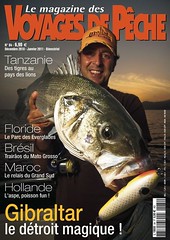
Front cover shot for the magazines: Voyages de Pêche, Mundo Pesca and Pesca&Barcos. Sb800 through Orbisflash


This image has already become the front cover for three different magazines: Pesca&Barcos in Spain, Mundo Pesca in Portugal and Voyages de Pêche in France. Is a shot that I love, perfect timing around sunset, great smile and amazing Sea Bass. I lit it with the SB800 through the Orbis Ring Flash, a wonderful combo for my fishing portraits

Thursday, November 18, 2010

Fall and the light

Fall is here, this week we had the first severe whip of the season after some beautiful days around 21C. My daughter came back home with a bunch of fallen leaves and she is pretty serious about painting them: “Before you paint them – I asked her – wouldn’t you like to take some photos of it?” She happily accepted and helped me setting up a transparent tray with a flash underneath it. To get a more even spread of the light, I put a Lumiquest Softbox III and on top of the flash a white piece of paper on top of the diffuser.

Nothing especially fancy of complicated, a very basic backlit studio set, just what I needed. I took the D90 with the Tokina 100mm f2.8 A-TX Macro and a small ladder and started playing with the light power on my CLS control. My daughter eventually lost interest in what I was doing and anyway had to do her homework, and the little old kid started shooting. The result is here, a “group” shot and a lone leaf, enough before we had a blackout and had to light up some candles to fix dinner….

Tuesday, October 19, 2010

A top ten Olive Oil

I have friends working on many different things, and I’m fascinated by the fact that some of them have developed qualities and skills to create something different. Among them my friend Vicky, pure Tuscan breed, wonderful woman and energetic person.

She lives in a beautiful farm on the Tuscan hills, her husband takes care of the day to day business with agriculture, hunting and livestock and she pulled up her chemistry skills to create something pretty unique and ultimately extremely valuable, olive oil. Not the regular greenish liquid we use day after day. She created something special, THE olive oil, winner of many different award and most likely than not, one of the 10 best olive oil available in this planet.

I love olive oil; I use it a lot and appreciate a good one, even though I’m not an expert. Before opening the half litre bottle that Vicky gave me, I took my time to shoot some photos of it, trying to figure out all the things I have learnt from the book Light science & Magic.

One SB800 went behind a white translucent plastic panel and the other on top of the bottle through a Lastolite 40” Umbrella box. Two white reflectors helped distributing the light evenly and in Lightroom I just whitened the white and added a bit of contrast and sharpening.

I finally tried the oil with some good friends at home. It gave life to a good Turbot and Tuna Carpaccio, but to get the pure taste we had to put it as it is on fresh bread…. Is not cheap stuff, as you can imagine, but is truly worth a try. You can find it here Fattoria di Monti, and by the way, is a magnificent place to stay if you want to visit Tuscany; they rent a very nice house.

Monday, August 9, 2010

LumiQuest Softbox III for fishing portraits

At last I could use the Lumiquest Softbox III for my fishing photos. I took it to Ireland and to be honest it really worked wonder. Compared to the sort of light I can get from a bare speedlight, this small softbox delivers a fairly radical change, providing a much softer light with less harsh shadows and certainly a way more interesting atmosphere.


It's compact, lightweight and foldable; it only takes less than a minute to mount it on the flash, quite some advantages when handling a fish on one side and the camera in the other, well quite literally.

From the pictures I've done in Kerry and Cork there is one that I favour over the others, and for one simple reason. Apart from the light which is nice, what strikes me is the reflection of the small softbox in the fish's eye, something, in my humble opinion, which works pretty well and is way cool.

On the next trip I will try to bring the Orbis Flash too, this time it wasn’t possible due to luggage overweight problems. I’m very curious to see what kind of reflection will leave in the fish’ eye.

Tuesday, August 3, 2010

Is the Euro still floating ?

A concept more than a photo. 5 cents floating on a thin layer of water poured on a black vinyl background. A side light provided by an SB800 through a Lastolite EzyBox to enhance the texture of the coin yet not reflect on the background, trying to keep it as black as possible.

Is our currency still floating? The Dollar is coming back strong and we are loosing power with the major international currencies. Maybe is good for the Euro zone export economy, but sure is not for those who import a lot of goods from non Euro countries.

Friday, July 30, 2010

The Flash tree.....

A brief video to see  what you need to overpower the desert sun.... Joe McNally shows what you can do with a bunch of speedlights properly used and packed together. If I had all those SB800s to use I would be a photographer in heaven, so much I love those little lights...

Tuesday, July 27, 2010

Lastolite EzyBox

A couple of videos for you to watch. Is an interesting lesson of how to set your Lastolite EzyBox and then how to use it. I got mine a while ago and I'm sure happy with it. Is lightweight, portable, and delivers a terrific light. The image here on the left has been taken with an SB800 through it. Check them out and then maybe you will want to get one yourselves


Thursday, July 22, 2010

Orbisflash for still life

For this test we found quite an unusual subject for the Orbisflash, a still life. I’m pretty sure that this ring flash was not designed for anything like that, but we had fun for half an hour trying different angles, and finally comparing it with a Lumiquest Softbox III, a Lumiquest Snoot and finally a bare SB800.


In this first image we have the Orbisflash on axis with the lens. That is, the lens goes through the hole :-) . The light gently wraps the whole subject

Now we moved the Orbisflash from the lens to camera left. The light is still nice and wrapping, we have more shadows and probably a more interesting picture

The Orbisflash is on top of the subject. This is the option I like the least, the light is a bit dull and there’s quite a loss of contrast and details.

Here we have the Lumiquest Softbox III right on top of the lens, trying to mimic the direction of light of the Orbisflash. The result is quite similar to that of image one, thus the light is not as wrapping and creates more edges

Lumiquest Softbox III on camera left. Compared to the second image we have more contrast here, darker shadows and stronger highlights. Is more contrasty

Softbox III on top of our garlic. The result is not too different from the one we made with the Orbisflash with the same settings.

Here we go for a very hard and narrow beam of light. The Lumiquest Snoot creates some kind of bad chiaroscuro, with very harsh and unflattering shadows.

Another hard light configuration. The SB800 is now bare, and the light again very unflattering. Lots of unpleasant contrast, same as in the previous example, yet we have a wider beam of light and it spreads more around the subject.

Monday, July 19, 2010

Orbisflash for macro work

I’m slowly getting familiar with the Orbisflash and this time I gave it a try with a macro subject. Working with the 60mm Micro Nikkor stuck at a mere 10cm from the lure, I did some fun testing


For works of this kind there is no other option but to place the camera on a tripod. Otherwise we would have the Orbis on the left hand and the camera in the other with both hands shaking and major focusing problems. Still, a sharp focus with a macro lens so close to the subject is extremely complicated. If you pay attention, even at f16 the depth of field is so limited that the metallic paint is not as focused as the eye, and I think the difference in depth between the two certainly cannot be spotted without a magnifying glass.

The Orbisflash, as many ring flash used in fashion photography, it gets reflected in a very unique way in the subject’s pupil. It is true that in the human eye is quite pleasing, very cool I’d say, I wanted to see if it would work as well on a plastic one, and to be very honest I believe it does. From the first to the second picture you can see we have slightly moved the Orbisflash from the lens axis to an off-camera position, and the reflection moved as well.

The light that provides such peculiar flash will sure have critics and devotee; I personally find it very cool. It wraps the subject in a very uniform shadowless way, yet not flat or dull, and delivers enough contrast to the image.

When I received it from the shop I thought it was a darn bulky monster, but now, after very little use I handle it with the same ease I handle my SB800 alone, and I am finding many and different applications for it.

Friday, May 21, 2010

Philothamnus thomensis, Sâo Tomé Green Snake

I’m not a nature photographer. Never approached any kind of wildlife and to be very honest I don’t even have the tools for the business. Thus, I’d love to be good at that, even though I think is a very complicated technique because you not only have to be a good photog, but also have a good knowledge of the wildlife, their behaviour and move your fat ass a lot to find them.


Another major issue is the lenses you need to capture such distant subjects but hey, if this is really what you like, instead of spending money like me in 20 different wide angle you just save the $$$ and get yourself a nice 200-400mm and off you go to the bush. Nevertheless, one day I’d love to treat myself to a nice trip just for this purpose, I’ll swap the fish for the land based critters.


Anyway, there are times when things just happen in front of your face and you can grab the chance and do some “wildlife” work. One afternoon, back from fishing, when I returned to my room at the hotel I saw a little Green Snake jumping from somewhere around me and hiding in a little bush nearby. I got closer and saw this little nice fellow sticking its head right out of the foliage apparently curious about me. I dropped my stuff, headed for the camera rigged with the 18-200mm, grabbed the SB800 with a Lastolite Pocket Bouncer and went back.


After few shots, with the snake absolutely unmolested and comfortable during the photo session, I went back to the room to change the lens. The Nikon 18-200 (the first image as been taken with this lens, the other two with the 60mm) is probably not the sharpest lens around hence I decided to go for the Nikkor 60mm micro, and what a difference it makes. Thus, with that lens I had to get closer, something that didn’t make me feel too comfortable, not knowing what kind of snake I had in front. Eventually everything run smooth and I had my shots, some good some not, but I was pretty excited about my vis a vis with the little green snake. Back to Madrid I did a little bit of investigation and discovered that it was absolutely harmless. Glad to know that I didn’t risk loosing my nose on that shot

Tuesday, May 18, 2010

Large diffusers, one more try

Today I wanted to give it a try to a new combo that I bought a while ago. Is a very large reflector, the Lastolite TriGrip and its specific bracket, that not only can support the diffuser but it also has an articulated arm to hold a flash to bounce the light off the diffuser.


It started as a stand alone test but whilst trying I decided to compare the results with another big Lastolite light modifier I got myself, the 1m Umbrella Box with 7mm shaft. They both are quite large light modifiers, at least for my minimalistic studio, among the largest I can deal with my small speed light.


The distance of the light from the subject is always the same. The shutter speed and f stop too, what I had to change a bit was the flash power rating in order to compensate the light absorption by each combination. For the sake of a comparison I also put a third image shot with a small LumiQuest Softobox III, of course the difference is staggering and is not fair to the little guy, but this is not what I wanted to prove, just to show how soft the light can be with a very large diffuser.


The fist image is shot with an SB800 at ¼ power bounced off a 1,20m Lastolite TriGrip on the Softsilver side (the other side is sunlite). As you can notice the light is extremely soft yet very scattered, with much diffused shadows, but quite poor in contrast. No reflector was used on the other side and in Lightroom I adjusted a bit the contrast, clarity and sharpening (the editing of the other image shave been synchronized with this on)


For this second take I used the Lastolite Umbrella Box. Same ratings as the previous image. The light is still soft and wrapping and the shadows less diffused. Due to the lesser spill of light the image is also a bit more contrast which I like a bit more. Being much closer to a softbox, with the Umbrella you have a better control over the light and it doesn’t scatter everywhere. I like this diffuser more and more


The third image shows how the light works when diffused by a small softbox. Imagine the difference in size from a 1,2 meters TriGrip, a 1 meter Umbrella and a 20cm softbox… Too much to handle.

In this final image you can see the TriGrip and the Umbrella Box together. Remember that the TriGrip is 1,2 meters, quite a huge thing, not too easy to handle and waaaaaay shaky on a light stand. I can see myself using it during one of my fishing trip and flying away with it like a kite surf at the first breeze. Thus, it can bounce the light over a standing subject and perfectly work as a fill light.